
In my previous post on AI coding frameworks, I described the AFK workflow at a high level. This is the follow-on: less about the idea, and more about what actually happens once work enters the system.
Before getting into it, I want to acknowledge
Matt Pocock’s skills,
particularly grill-with-docs. That workflow was an important influence
on how I think about context.
For me, the useful part is not simply the grilling itself. The grilling
produces durable artefacts: Architectural Decision Records (ADRs) and a
context.md that captures the decisions, assumptions and boundaries that
would otherwise live only in a conversation.
An Architectural Decision Record (ADR) is a short document that records an important technical or architectural decision: the problem being solved, the options considered, the decision that was made, and the reasoning behind it. The value is not just knowing what the architecture looks like, but preserving why it looks that way.
A Product Requirements Document (PRD) describes what the product or feature is supposed to achieve. It captures the problem, goals, scope, requirements, constraints and acceptance criteria before that work is broken down into implementation tasks.
A directed acyclic graph (DAG) is a collection of work items connected by dependencies that point in one direction and never form a loop. In this workflow, each issue is a work item: an issue can become ready when the issues it depends on have been completed, while independent issues can proceed in parallel.
From there, the PRD becomes implementation issues, and those issues form the dependency graph the AFK workflow executes.
I have taken that idea and built it into a broader workflow around persistent repository context, issue DAGs, task routing, event-driven orchestration, bounded developer agents and adversarial review.
The interesting part, at least for me, is not getting an agent to write code. That part is increasingly easy.
The harder problem is giving an agent enough context to do useful work without giving it the entire world, deciding which agent should do the work, constraining what it is allowed to touch, and then making sure another agent is prepared to tell it that its implementation is wrong.
That is what the AFK workflow is really doing.
Every Agent Wakes Up With Amnesia
One of the mental models I use for AI agents is a slightly nerdy one: Johnny Mnemonic.
Each agent starts a job effectively brand new.
It does not have the lived history of the project. It was not in the grilling session. It does not remember why a particular architectural decision was made three weeks ago. It does not know which alternatives were considered and rejected unless I give it that information again.
That changes how I think about “memory”.
I do not want the workflow to depend on an agent remembering a previous conversation. I want the repository itself to carry the memory.
That is why the output from planning matters so much:
Grilling
   |
   +--> context.md
   |
   +--> ADRs
   |
   +--> PRD
          |
          v
       Issues
          |
          v
   Dependency DAG
context.md gives an agent the project-level orientation it needs.
ADRs preserve the reasoning behind important architectural decisions, including the alternatives and constraints behind them.
The PRD turns the idea and its requirements into defined product work.
The issues turn that product work into executable units, and their dependencies define the order in which those units are safe to execute.
In that sense, Git is doing more than versioning code. It is acting as the durable memory substrate for a set of otherwise stateless agents.
A fresh agent can arrive, read the relevant project memory, receive a bounded task, and operate without needing the entire history of every conversation that came before it.
That is the strategy: do not rely on the agent to remember the project; make the project remember itself.
Spend Tokens Up Front
One of the design choices I have made is that I am quite happy to spend tokens up front.
I do not try to make the planning phase artificially cheap.
I use grilling sessions to get an idea out of my head and make the assumptions explicit. I write Architectural Decision Records (ADRs). I spend time defining the problem, the boundaries and the decisions that have already been made.
That context is an investment.
The payoff comes later, when the implementation agents do not need to rediscover the architecture every time they are given a task.
Instead of handing a developer agent an issue and effectively saying, “Here is the repository; work it out,” I can give it a much smaller problem.
That matters because context windows are not free. More context does not automatically produce a better result. A large context window can contain a lot of information that is irrelevant to the task at hand.
My approach is therefore almost the opposite:
Spend context deliberately during planning so that execution can operate on less context.
This is also why I do not use one giant agent for the whole workflow.
The Council: Challenging the Idea Before There Is Code
There is an additional step when I am starting a brand new project.
I call it the Council.
The Council is not part of normal feature development and it is not something every issue passes through. If I am adding a feature to an existing project, the Council normally has nothing to do with it.
It exists for greenfield work, where the architecture itself is still being decided.
The important distinction is that the Council is not there to challenge another agent.
It is there to challenge me.
I treat it a bit like an adversarial architecture board. I bring the idea, and the Council pushes on it: assumptions, boundaries, alternatives, failure modes, unnecessary complexity and decisions I may be making without realising I have made them.
Each Council member plays a distinct role. The Product Owner validates whether the problem is real, whether the proposed value is genuine, and whether the scope is right-sized. The Platform Architect pushes on architectural boundaries, operational concerns and blast radius — what does this change touch, and does the architecture actually support it? The Senior Engineer validates complexity, edge cases and maintainability — is this the simplest version that works, and can someone else pick it up later? The Delivery Planner validates the decomposition into issues and cost efficiency — does this break down into work that is genuinely independent, and are the issue sizes sensible?
The Council operates in up to two rounds. In each round, every role writes an independent opinion. There is a convergence gate between rounds: if average confidence is at least 0.85, there is no dissent, and no role has made round-two requests, the second round is skipped. That keeps the process lightweight when an idea is already solid, while still allowing a second pass when the first round surfaces genuine disagreement.
For low-risk ideas, the full four-role Council is overkill. I use a lightweight tier instead: just the Product Owner plus one technical role. That keeps the overhead proportional to the risk.
The output of the Council process is stored under
.ai/council/{session-id}/ — the individual briefs, per-role
opinions, the decision YAML, PRD outlines and issue breakdowns. Those
artifacts become part of the durable project context that downstream
agents can read.
And a scope reminder: the Council exists for greenfield projects only. If I am adding a feature to an existing codebase, the architecture is already decided. The Council is not relevant there.
The purpose is not to generate code. The purpose is to make the idea harder to misunderstand.
The output of that process becomes durable project context: ADRs, architectural boundaries, decisions, risks and eventually well-defined pieces of work.
Once that exists, the Council gets out of the way.
The normal AFK workflow can begin.
The Plan Becomes a DAG
The grilling process does not just produce a flat backlog of issues.
As the work is broken down, it also captures the dependencies between those issues. The result is a directed acyclic graph (DAG) of implementation work.
That distinction matters.
An issue is not ready to run simply because it exists or has been added to the backlog. It becomes eligible for execution when the issues it depends on have reached the required state.
A simplified plan might look like this:
                 +--> Issue B --+
Issue A ---------+              +--> Issue D
                 +--> Issue C --+
Issue A has to be completed before B and C become eligible. Once both branches have satisfied their dependencies, Issue D can proceed.
This gives the AFK workflow something more useful than a queue. It gives it an execution plan.
Independent branches of the DAG can progress without waiting for unrelated work, while dependent work stays blocked until the context it relies on actually exists. That means concurrency comes from the shape of the plan rather than from simply throwing more agents at the backlog.
The DAG is also another place where the upfront planning work pays off. During grilling I am not only asking what needs to be built? I am working out in what dependency order can it safely be built?
By the time an issue reaches an implementation agent, the agent should not need to reconstruct that project plan for itself.
The Issue Is the Handoff
By the time work reaches the AFK pipeline, I want the architectural thinking to have already happened.
The issue is therefore more than a to-do item. It is the handoff between planning and execution.
It carries the intent of the work, acceptance criteria, relevant context and references back to the decisions that led to it.
But I still do not hand that entire body of context directly to a developer agent.
There is another step first.
The Task Router Is Where the Work Gets Bounded
The Task Router is probably the most important part of the execution pipeline.
Its job is not simply to look at a task and choose an agent.
It reduces the problem.
Given an issue and the project context, the Task Router determines what kind of work this is and produces a bounded execution plan. That can include things such as:
- which developer role should take the task;
- which files or directories are relevant;
- which parts of the repository are out of scope;
- the constraints the developer needs to respect; and
- what the expected result should look like.
I currently use different developer roles — junior, mid-level and senior — rather than treating every implementation task as if it requires the same agent with the same context.
The point is not to role-play an engineering organisation.
The roles give me a way to route different classes of work to different prompts, capabilities and levels of reasoning.
More importantly, the router can give the selected developer only the context it actually needs.
That is where the upfront investment in grilling sessions and ADRs starts paying for itself.
The planning context can be large. The execution context does not have to be.
Use Traditional Code Wherever You Can
One of the most important principles in this workflow is that AI should not be used simply because AI is available.
If a part of the workflow can be implemented reliably with traditional code, I prefer to do that.
Traditional software is predictable. Given the same inputs and the same state, I can expect the same behaviour. I can test it, version it, reason about it and run it repeatedly without wondering whether the implementation will interpret the task differently on the next execution.
That makes traditional code a much better fit for things such as:
- receiving and validating webhooks;
- normalising payloads;
- transporting events;
- evaluating known state transitions;
- checking whether dependencies are satisfied;
- triggering jobs;
- moving work between well-defined workflow states; and
- enforcing hard constraints.
AI is most useful where the work is inherently less deterministic: interpreting a requirement, creating or transforming content, planning an implementation, writing code, or reviewing a change.
I do not want an LLM deciding how to move an event from one system to another if a few lines of deterministic code can make that decision perfectly well.
A useful rule of thumb for this architecture is:
Use code for control flow. Use AI for content and judgement.
That separation is part of what makes the AFK workflow repeatable. The automation surrounding the agents is deliberately conventional. The agents operate inside that automation rather than replacing it.
Where This Workflow Fits — and Where It Does Not
This workflow is not intended to handle every kind of engineering work.
The main use cases I designed it for are:
- new feature implementation;
- bug fixes; and
- other bounded pieces of repository work that can be described clearly, routed to the right agent, implemented, and reviewed.
Those are good candidates because they naturally fit the model used throughout the AFK workflow: defined context, bounded scope, explicit dependencies, implementation, and review.
There are plenty of cases where that machinery would be unnecessary or even counterproductive.
A tiny change may be faster for a person to make directly than to send through the full agent pipeline. Some problems are ambiguous enough that the correct next step is a conversation rather than another automated job. And sometimes an agent reaches a point where it should stop rather than guess.
For small, bounded changes and some bug fixes, I still interact directly with the agent rather than forcing every change through the complete AFK workflow from the beginning.
That is especially useful when a problem is found in the middle of an existing review cycle. If the reviewer identifies a small bug or a narrowly scoped issue, I can tell the developer agent to fix that specific problem directly.
The important part is that this does not break the surrounding workflow. Once the developer has made the change, the same event-driven architecture can pick the work back up and continue using the existing framework: the repository event is emitted, the automation reacts, and the change flows back through the appropriate review and execution stages.
So the workflow is not all-or-nothing. I can interact with an agent directly for a small correction while still using the deterministic orchestration around it to resume the larger process.
Sometimes the overhead of starting the complete pipeline from scratch is simply not justified. If the change is small enough, it is faster and clearer for me to stay in the loop, give the agent the context it needs, review what it does, and then let the existing automation continue from there.
There are also cases where an AI agent escalates a problem because it cannot safely resolve it within the context and constraints it has been given.
An escalation is not a failure of the system. In many cases it is the correct behaviour.
I would much rather have an agent say, “I do not have enough information to make this decision safely,” than invent an architectural decision simply to keep the workflow moving.
The goal is therefore not full autonomy at any cost.
It is bounded autonomy with explicit escape hatches back to a human.
From an Event to an AWX Job
The orchestration around the agents is event-driven.
At a simplified level, the path looks like this:
Issue / repository event
        |
        v
     Webhook
        |
        v
 FastAPI gateway
        |
        v
      Kafka
        |
        v
Event-Driven Ansible
        |
        v
       AWX
        |
        v
   Agent workflow
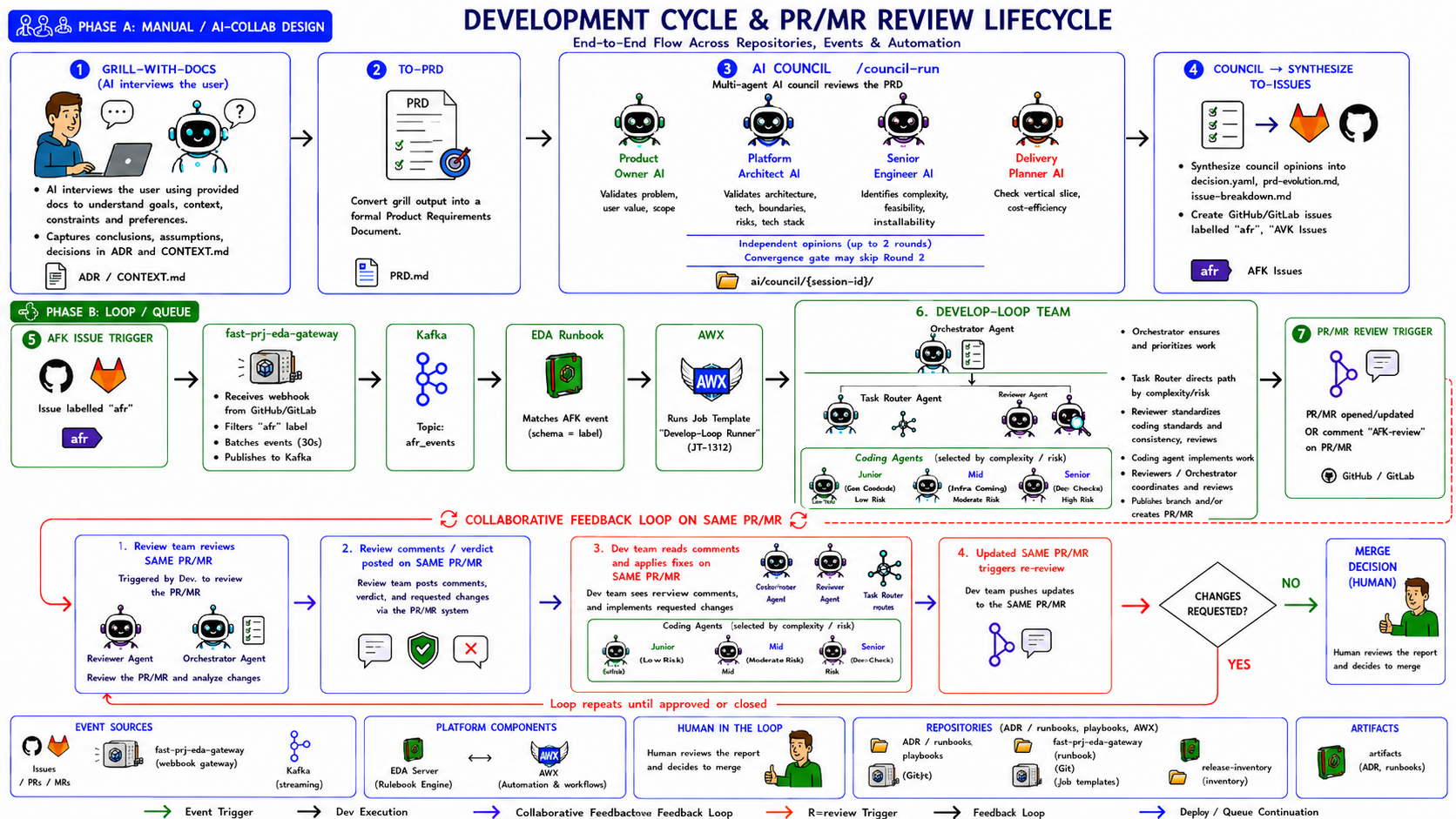
A webhook hits my FastAPI application, which validates and normalises the event before publishing it into Kafka.
From there, Event-Driven Ansible picks up the relevant event and payload. The matching rule then hands the work to AWX, which launches the appropriate job.
Event-Driven Ansible (EDA) is the event-processing layer. Instead of waiting for a person or a scheduled job to start automation, it listens for events and evaluates them against rules. When an event matches a rule, EDA decides what automation should happen next. In this workflow, that means taking an event from Kafka, inspecting the payload, and triggering the appropriate downstream job.
That is useful in cases where polling or scheduled automation is the wrong model. A scheduled job asks, “Is there anything for me to do yet?” every few minutes. EDA can instead react when the relevant event actually occurs.
For this workflow that matters because work does not become ready on a clock. An issue becomes executable when its state changes, when a dependency in the DAG is satisfied, or when a review produces a new verdict. Those are events, not times of day.
That does not mean event-driven automation is always better than a schedule. Scheduled jobs are still a good fit for periodic work such as nightly maintenance, reports or regular reconciliation. But where the trigger is a change in system state, EDA lets the automation respond to that change directly rather than repeatedly polling for it.
AWX is the automation execution platform I use to run those jobs. It is the upstream open-source project behind the automation controller in Red Hat Ansible Automation Platform. AWX gives me centrally managed Job Templates, inventories, credentials, execution environments and job history, so the agent workflow runs as controlled automation rather than as an ad-hoc process on my laptop.
Put another way: EDA decides when and what to run; AWX runs it.
I could wire the repository event directly to an agent runner, but I deliberately do not.
The separation gives me boundaries between the system that receives an event, the system that transports it, the rules that decide what the event means, and the system that actually performs the work.
That makes the agent another worker in an automation system rather than the automation system itself.
The Developer Does a Bounded Job
Once AWX starts the development job, the selected developer agent receives the bounded task produced by the router.
At this point I want the developer to be boring.
It should not be redesigning the project. It should not be reconsidering architectural decisions that were already made. It should not be wandering through unrelated parts of the repository because they happen to fit in the context window.
Its job is implementation.
That separation is deliberate:
Human / Council     -> Why are we building this?
Planning / ADRs     -> What decisions and constraints already exist?
Task Router         -> What exactly is this task allowed to touch?
Developer           -> Implement the bounded change.
Reviewer            -> Try to prove the implementation is wrong.
Each stage gets a different problem to solve.
The First Review Loop: Diff Review
After the developer produces a change, it does not immediately become a merge request.
There is an internal diff review first.
This is the one part of the execution pipeline where I allow an immediate back-and-forth loop. The diff reviewer examines what the developer changed and can send it directly back to the developer to fix problems.
The developer fixes the issue. The diff is reviewed again.
That loop can happen as many times as necessary.
The purpose is to catch implementation errors while the work is still inside the execution pipeline, before promoting it into the external merge-request review process.
The Reviewer Is Supposed to Be Adversarial
I intentionally make the reviewer adversarial.
I do not want a reviewer whose default behaviour is to agree with the developer.
The developer’s job is to make the implementation work.
The reviewer’s job is to find reasons it might not.
That means challenging assumptions, checking whether the implementation actually satisfies the task, looking for unintended changes and refusing to approve work just because the code looks plausible.
This is an important part of the multi-agent design.
Using multiple agents is not particularly useful if they all share the same goal and spend their time agreeing with one another.
I want tension between the roles.
The External Merge Request Review Loop
Once the internal execution pipeline is satisfied with the change, a merge request is created.
That begins a separate review loop.
The external reviewer examines the merge request and produces a verdict.
If the verdict is Request Changes, the work goes back to the developer — together with the reviewer’s comments.
The developer does not simply rerun the original task. It reads the reviewer’s feedback, responds to the specific points raised, updates the implementation where required, and pushes the revised change back to the merge request.
The reviewer then evaluates both the developer’s response and the new diff. If it is still not satisfied, it can request further changes and the developer responds again.
So this is a genuine developer-reviewer conversation expressed as an automated feedback loop:
Developer
    |
    | implementation
    v
Merge Request
    |
    v
Adversarial Reviewer
    |
    | Request Changes + review comments
    v
Developer
    |
    | responds to comments + updates code
    v
Merge Request
    |
    +---------------------> Adversarial Reviewer
                              |
                              +-- Request Changes --> Developer
                              |
                              +-- Approve --> Ready for next stage
There is no assumption that review happens once, or even twice.
It continues until the reviewer is prepared to return Approve.
That is a subtle but important distinction in how I think about agentic workflows. I am not asking a sequence of agents to each take one turn. I am creating bounded feedback loops with explicit exit conditions.
Walking One Task Through the Pipeline
Putting those pieces together, a normal piece of work on an existing project looks roughly like this:
- I create or refine the issue using the architectural context that already exists.
- A repository event triggers the AFK workflow.
- The webhook reaches the FastAPI gateway.
- The gateway validates and normalises the payload and publishes the event to Kafka.
- Event-Driven Ansible consumes the relevant event.
- EDA triggers the appropriate AWX job.
- The Task Router interprets the issue and creates a bounded execution plan.
- The router selects the appropriate developer role and limits the working context and file scope.
- The developer implements the change.
- The diff reviewer inspects it and can send it back to the developer repeatedly until the immediate implementation problems are resolved.
- A merge request is created.
- The adversarial external reviewer reviews the merge request and leaves specific feedback.
- A Request Changes verdict sends that feedback back to the developer.
- The developer responds to the review comments, updates the implementation, and pushes the revised change.
- The reviewer evaluates the developer’s response and the new diff.
- Developer and reviewer continue that conversation until the verdict is Approve.
For a greenfield project, there is one extra phase before all of this: I go through the Council and the planning/grilling process first so that the architecture and context exist before I start generating implementation tasks.
Why Split the Workflow This Way?
There is a temptation with coding agents to keep adding context and capability to one increasingly powerful agent.
I have gone in the other direction.
I would rather have several agents with narrower jobs, explicit handoffs and smaller context windows.
The Council challenges the human.
The Task Router constrains the work.
The developer implements it.
The diff reviewer catches immediate implementation problems.
The external reviewer challenges the merge request until it is prepared to approve it.
And the event-driven infrastructure moves work between those stages without requiring me to sit in front of the terminal and shepherd every transition.
That is what AFK means for me.
It does not mean removing the human from engineering. I still invest heavily in the decisions, context and boundaries at the beginning.
It means that once I have defined the work properly, I do not need to babysit every execution step.
The autonomy comes from the constraints.
And the continuity comes from the repository.
The agents can be disposable. The context cannot be.
And the agents should not own the parts of the system that ordinary software can do more reliably.
That is probably the most important point in the whole design: this is not an attempt to replace an engineering system with AI. It is an engineering system that uses AI selectively, inside boundaries enforced by deterministic software.
My Kafka, EDA, AWX and FastAPI setup is simply one implementation of that idea. The framework matters more than the products.
Autonomy Is Not the Same as Removing Humans
AFK does not mean I am trying to remove myself from software engineering.
It means I want the routine parts of bounded implementation work to continue without me having to manually shepherd every transition.
Humans still matter at the points where judgement, missing context or risk make automation the wrong choice.
Sometimes that means I make a small fix directly.
Sometimes an agent escalates a decision back to me.
Sometimes the right outcome of a run is not another commit, but a request for more context.
That is intentional.
A useful AFK system should know not only how to continue, but also when to stop and ask for help.
My Stack Is an Implementation, Not a Requirement
My particular implementation uses Kafka, Event-Driven Ansible, AWX and a custom FastAPI application because I already had that infrastructure available and I know how to operate it.
That does not mean someone implementing this pattern needs the same stack.
You could build the same basic workflow with a much smaller set of tools: a CI system, a queue, a webhook receiver, a workflow engine, GitHub Actions, GitLab CI, or even a carefully designed application that handles the state machine directly.
The technologies are not the important part.
The important parts of the framework are the responsibilities they represent:
Durable project context
        |
        v
Work decomposed into a dependency DAG
        |
        v
Deterministic orchestration
        |
        v
Task routing and context bounding
        |
        v
Specialised implementation agents
        |
        v
Adversarial review loops
        |
        v
Explicit state transitions and exit conditions
The thing I want readers to take away is not, “I need Kafka and AWX to build an AFK coding workflow.”
It is:
Understand which parts of the system need deterministic automation, which parts benefit from AI, and put explicit boundaries between them.
Once those boundaries are clear, the underlying tools can be swapped for whatever makes sense in your environment.